
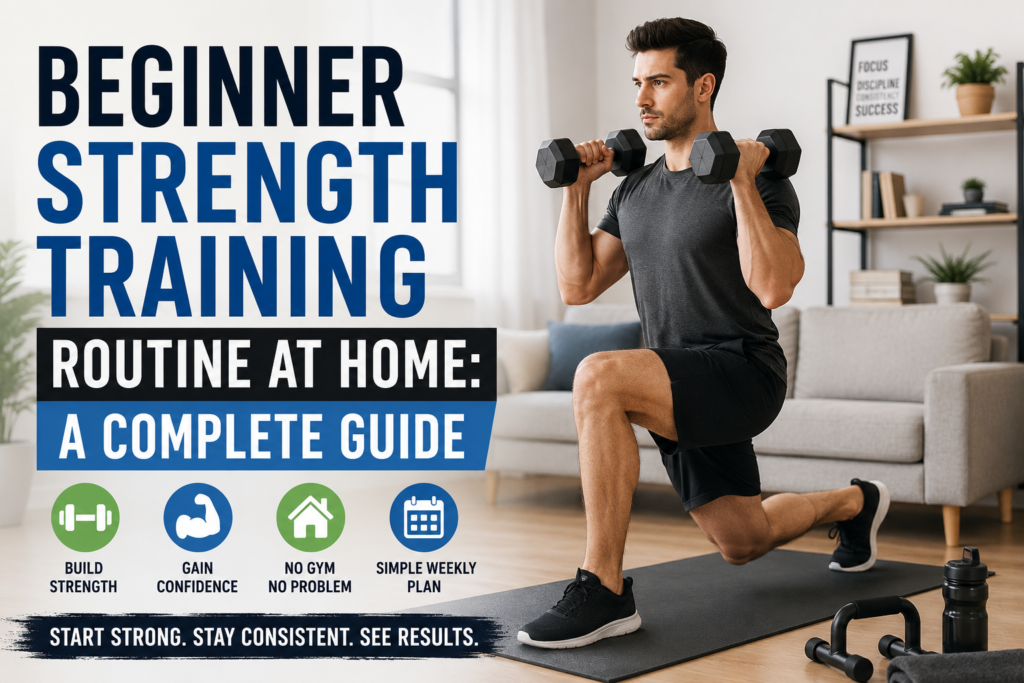
I can guess that you have wanted to start exercising for some time now. It might be that you bought yourself a gym membership in January, and after going there four times, you just stopped. It could also be that you are scared of entering a gym where you are going to be surrounded by people who definitely know what they are doing. Or maybe it is the case that you simply don’t have enough time or money to pay for a gym membership, and you wonder if you can develop your strength any other way.
The answer to that question is positive, and I will try to show you how.
A home workout program for beginner strength training is not a concession that you will have to resort to until you finally get yourself a gym membership. Most often, it is the more sensible option anyway.
I have had the experience of training beginners of all levels, and the most common mistake is not taking it easy enough. It is making it overly complex before the fundamentals are nailed down. Here, you are going to find a workout program that works, and explained in a way that makes sense.
Why Home Strength Training Works for Beginners
It makes sense to have a clear understanding of why this method really works instead of merely being a matter of convenience.
The fact is that when you start with strength training, your body responds well to almost any form of resistance. You don’t need to use heavy weight plates on a barbell to grow muscles and become strong in the first several months of your workouts. As was proven by research published in the Journal of Strength and Conditioning Research, bodyweight exercises are as efficient as strength machines in providing untrained individuals with adaptation to training.
The reason for this is the fact that the majority of initial strength increases in a beginner will be due to neuromuscular adaptations; you’re teaching your brain how to activate and coordinate the fibers more effectively without having them physically grow bigger. Your body doesn’t really care whether the resistance comes from a barbell or from your body weight. It reacts to overcoming resistance with purpose and intent.
The effectiveness of home-based workouts in building muscular strength, endurance, and body composition was proven in a 2021 article in the International Journal of Environmental Research and Public Health. The keyword here is “consistently,” and being consistent is exactly what a home-based beginner’s strength routine can help you do.
What You Actually Need to Get Started
Among the many advantages of a beginner strength workout at home, one is the minimal amount of equipment that can still provide you with significant results during the first months of exercising.
The strictest minimum is nothing at all. Your body weight is more than enough as resistance for squats, push-ups, lunges, glute bridges, and rows if you happen to have a solid table or a low bar. And that is all you need to form an efficient program.
However, if you wish to spend a little bit on it, you will be able to acquire three types of resistance bands from $15 to $30. Adjustable dumbbells will provide you with additional variations and develop alongside your progress. A pull-up bar to fix on the door frame will cost you approximately $30 and give access to a wide variety of upper body pulling exercises.
The only thing you need is a place that is about six feet wide and long, a mat or carpeted floor, and about 30 to 45 minutes, three times a week.
Understanding the Basics Before You Start
A few concepts are worth understanding before you begin your beginner strength training routine at home because they will make everything in the program make more sense.
Sets and repetitions: One repetition is one single movement. One set is a series of consecutive repetitions. If the workout plan calls for 3 sets of 10 repetitions, you do 10 repetitions, take a break, and do it two more times.
Progressive overload: It is the most critical concept in strength training and, at the same time, it is the concept that almost no beginner knows. The human body adjusts to stress and does not respond to it when it becomes predictable. Progressive overload is a continuous increase in difficulty of your workout, achieved by doing more repetitions, more sets, using more weight, or increasing movement tempo.
Rest periods: For strength training, rest between sets matters more than most beginners think. Sixty to ninety seconds of rest between sets allows enough recovery for the next set to be genuinely challenging rather than just exhausting. Do not skip the rest.
Form over everything: Moving with correct form through a full range of motion does more for your development than rushing through sloppy reps with more resistance than you can control. Learn the movement pattern first. Add difficulty second.
Read Also: Protein for Muscle Growth: Foods, Supplements, and Expert Tips
The Beginner Strength Training Routine at Home
This program runs three days per week on non-consecutive days. Monday, Wednesday, Friday works well. Tuesday, Thursday, Saturday works equally well. What matters is having at least one rest day between sessions.
The program uses a full-body approach each session because research consistently shows that training each muscle group more frequently produces better strength and muscle gains in beginners than splitting the body into separate days.
Warm Up: 5 to 8 Minutes
Never skip this. A proper warm-up increases muscle temperature, improves joint mobility, and meaningfully reduces injury risk.
Jumping jacks — 30 seconds
Arm circles forward and backward — 30 seconds each direction
Hip circles — 10 each direction
Bodyweight squats slow and controlled — 10 reps
Inchworms — 5 reps, walk hands out to plank position and back
Leg swings front to back — 10 each leg
The Main Workout
Exercise 1: Bodyweight Squat
Sets: 3 | Reps: 12 to 15 | Rest: 60 seconds
Stand with feet shoulder-width apart, toes turned out slightly. Push your hips back and down like you are sitting into a chair behind you. Keep your chest up and knees tracking over your toes. Lower until your thighs are parallel to the floor or as close as your mobility allows. Drive through your heels to stand back up.
The squat trains your quadriceps, hamstrings, glutes, and core simultaneously. It is the most important lower body movement pattern you will ever learn.
Progression: When 3 sets of 15 feel manageable, add a pause at the bottom for 2 seconds, then progress to single-leg variations.
Exercise 2: Pushup
Sets: 3 | Reps: 8 to 12 | Rest: 60 seconds
Start in a plank position with hands slightly wider than shoulder-width. Lower your chest to the floor while keeping your elbows at roughly 45 degrees from your body, not flared out wide. Push back up to the starting position without letting your hips sag or your lower back arch.
If full pushups are not yet possible, perform them with knees on the floor. This is not a beginner modification to be embarrassed about. It is a legitimate exercise that builds the pushing strength needed for full pushups.
The pushup trains your chest, shoulders, triceps, and core. It is the foundational upper body pushing movement of this beginner strength training program at home.
Progression: Progress from knee pushups to full pushups, then to feet elevated pushups, which increase chest recruitment.
Exercise 3: Glute Bridge
Sets: 3 | Reps: 15 | Rest: 60 seconds
Lie on your back with knees bent and feet flat on the floor hip-width apart. Drive your heels into the floor and lift your hips until your body forms a straight line from knees to shoulders. Squeeze your glutes hard at the top and hold for one second before lowering.
The glute bridge directly trains the glutes and hamstrings and teaches the hip hinge pattern that underlies deadlifts and dozens of other exercises you will eventually progress to.
Progression: Progress to single-leg glute bridges, then to hip thrusts with feet elevated on a couch or chair.
Exercise 4: Reverse Lunge
Sets: 3 | Reps: 10 each leg | Rest: 60 seconds
Stand tall and step one foot backward, lowering your back knee toward the floor while keeping your front shin as vertical as possible. Push through your front heel to return to standing. Alternate legs or complete all reps on one side before switching.
The reverse lunge is easier on the knees than a forward lunge and trains each leg independently, which identifies and helps correct strength imbalances between sides.
Progression: Progress to walking lunges, then to deficit reverse lunges with your front foot elevated on a step.
Exercise 5: Plank
Sets: 3 | Duration: 20 to 40 seconds | Rest: 45 seconds
Support yourself on forearms and toes with your body forming a straight line from head to heels. Brace your core like you are about to take a punch, squeeze your glutes, and breathe steadily. Do not let your hips sag toward the floor or pike up toward the ceiling.
Core strength is not just about aesthetics. It is the foundation of every other movement in this program and a direct predictor of lower back health as you progress to heavier training.
Progression: Progress from static plank to plank shoulder taps, then to plank with alternating leg raises.
Exercise 6: Inverted Row or Resistance Band Row
Sets: 3 | Reps: 10 to 12 | Rest: 60 seconds
This is the pulling movement that balances all the pushing work. If you have a sturdy table, lie underneath it, grip the edge, and pull your chest up toward the surface, keeping your body in a straight line. If you have a resistance band, anchor it to a door, hold one end in each hand, and pull your hands toward your lower ribs while keeping elbows close to your body.
Upper back pulling strength is critically undertrained in most beginner programs and directly affects posture, shoulder health, and your ability to progress safely in all upper body exercises.
Progression: Progress to a more horizontal body position for rows, or heavier resistance bands.
Cool Down: 5 Minutes
Standing quad stretch — 30 seconds each leg
Seated hamstring stretch — 30 seconds each leg
Child’s pose — 45 seconds
Chest opener stretch — 30 seconds
Hip flexor stretch — 30 seconds each side
Your Weekly Schedule
| Day | Session |
| Monday | Full body workout |
| Tuesday | Rest or light walking |
| Wednesday | Full body workout |
| Thursday | Rest or light walking |
| Friday | Full body workout |
| Saturday | Active recovery, stretching, walking |
| Sunday | Full rest |
How to Progress Over Time
And this is the place where most basic programs fail. They provide you with exercises without any further instruction on how to proceed when those exercises become too easy for you.
Here is one reliable progression scheme that could be used during the first six months of a basic strength training program.
Weeks 1-2: Concentrate only on acquiring the movement patterns. Forget about getting to the top of the rep range. Be slow and deliberate in your execution.
Weeks 3-4: Strive to get to the top of the rep range with all sets. Once you have been able to do so with all sets in two consecutive workouts, it’s time to progress.
Weeks 5-8: Progress by adding some difficulty factor in accordance with the progressions provided under every exercise. Alternatively, just add 1-2 reps per set per week.
Weeks 9-12: Increase the difficulty by introducing some sort of resistance, either resistance bands or light dumbbells, in the exercises that became too easy to do using just your body weight. Replace bodyweight squat with a goblet squat with a dumbbell. Replace inverted row with dumbbell row.
Research published in Sports Medicine found that beginners following a progressive overload protocol gained three times more strength over 12 weeks than those who trained at a fixed difficulty level. The progression is not optional. It is the mechanism of improvement.
Read Also: 14 Signs of Vitamin D Deficiency in Adults: Causes, Symptoms & Treatment
Nutritional Fundamentals to Help You Train
In order to help yourself while strength training from home, there is no need to have an overly complex nutrition plan. Nevertheless, some fundamentals will definitely help you reach your goals faster and perform better in the gym.
First of all, the key component of your diet should be protein. They serve as the building blocks for muscles. In order to regenerate and grow after the workout, your body needs to have a sufficient amount of protein taken from the food that you eat. It was proven by research that people who train regularly should take 0.7 – 1 gram of protein intake per pound of bodyweight per day. Such foods include eggs, chicken, fish, Greek yoghurt, cottage cheese, beans and lentils.
Make sure to consume enough food. Not only does the severe restriction of calories when starting strength training seem impractical, but it stops you from reaching your goals because your body needs the energy to exercise and adapt to it. If you aim to lose fat, then a 200-300 calorie deficit would be reasonable.
Dehydration impairs performance more than most people would think. A study published in the Journal of Athletic Training reveals that even as little dehydration as 2% of one’s body weight decreases strength capacity.
The adaptation takes place during the sleep period. You do not build muscles during your workout but during sleep when your growth hormone is secreted, and there is maximum synthesis of the muscle proteins. Getting 7 to 9 hours of sleep is not a luxurious choice of lifestyle when you are doing strength training.
Typical Mistakes That Beginners Make
There is always a set of mistakes made by beginners after having worked with them for some time.
Working out daily within the first week. Excessive enthusiasm is good, but it needs rest for the muscles to heal and to become stronger. The presence of sore muscles before the next training shows that you have not completed your adaptation period yet.
Neglecting the warm-up: Your muscles become stiff and easy to strain without warming them up. Warm-up should last about five minutes.
Moving too quickly: Slow and controlled movements through a full range of motion are better than fast ones through a part of it. A two-second lowering and one second pause at the bottom of every repetition is one of the simplest rules improving your exercises instantly.
Comparing progress to others: Strength training progress is individual and non-linear. Some weeks you will feel stronger than the week before. Some weeks you will not. Both are normal. The only comparison that matters is you this month versus you last month.
Stopping when it stops being easy: Discomfort is how strength training works. The last two reps of a set should be genuinely challenging. If they are not, the stimulus for adaptation is not there.
Tracking Your Progress
Keeping a simple training log changes everything. You do not need an app or a complicated spreadsheet. A notebook works perfectly.
Write down the date, the exercises you did, the sets and reps you completed, and how each session felt. Review it every two weeks. Seeing documented progress- more reps than last month, an exercise that felt hard that now feels manageable- is one of the most motivating things you can do for long-term consistency.
Take a simple measurement every four weeks. Waist circumference, a progress photo, or a timed test like how long you can hold a plank. Strength changes happen gradually and are easy to miss without objective markers to look back at.
Frequently Asked Questions
Q1: How long before I see results from a beginner strength training routine at home?
Most beginners notice improved energy, better sleep, and reduced muscle soreness within two to three weeks of starting consistently. Visible changes in muscle tone and body composition typically become apparent between six and twelve weeks depending on nutrition, sleep quality, and consistency of training. Strength gains, meaning exercises that were difficult become noticeably easier, often appear within the first three to four weeks because early strength improvements are primarily neurological rather than structural.
Q2: Is a beginner strength training program at home as effective as going to a gym?
For the first three to six months of training, yes. Research consistently shows that untrained individuals gain comparable strength from bodyweight and minimal equipment programs compared to gym-based programs during the initial adaptation phase. Beyond six months, a gym environment with heavier progressive resistance becomes increasingly advantageous for continued strength and muscle development. Many people use a home program to build the habit and movement foundation before transitioning to a gym, which is a genuinely smart approach.
Q3: How sore should I expect to be when I start?
Some muscle soreness in the 24 to 72 hours after your first two to three sessions is completely normal and is called delayed onset muscle soreness. It is caused by microscopic muscle fiber damage that repairs and adapts stronger. Soreness should feel like muscle fatigue and tightness, not sharp or joint-based pain. The first week tends to produce the most soreness. By week three, most beginners notice significantly less post-workout discomfort as the body adapts.
Q4: How many days a week should a beginner do strength training at home?
Three days per week with rest days between sessions is the evidence-based recommendation for beginners and is exactly what this program is designed around. This frequency provides sufficient stimulus for strength development while giving muscles adequate recovery time. Training more frequently as a beginner does not produce faster results and significantly increases injury risk and burnout probability.
Q5: Can I lose weight with a strength training routine for beginners at home?
Strength training supports fat loss through two mechanisms. It burns calories during the workout itself, and it increases your resting metabolic rate over time by building muscle tissue, which burns more calories than fat tissue at rest. Research from Harvard Medical School found that people who strength trained regularly gained less abdominal fat over 12 years than those who did cardio exclusively. For fat loss, combining this program with a modest calorie deficit and adequate protein intake produces more sustainable and visually satisfying results than cardio alone.
Q6: What if I cannot do a full pushup yet?
Start with knee pushups and work them consistently. Most beginners who cannot perform a full pushup at the start of this program can do 8 to 10 full pushups within six to eight weeks of consistent knee pushup training. There is no timeline pressure. Building the strength correctly is far more important than rushing to the full version before your body is ready for it.