
Let me tell you something that happened in my friend’s office six months ago.
His company had been debating whether to invest in AI tools for their sales team. The debate went on for nearly a year. Legal concerns. Budget concerns. Change management concerns. By the time they finally approved a modest pilot program, their biggest competitor had already automated 60% of their outbound sales process, cut their cost per acquisition by a third, and was growing faster than anyone in the industry expected.
My friend’s company is now playing catch-up. In technology, catch-up is a very expensive place to be.
I share that story because it captures exactly what makes 2026 different from previous years when technology trend articles felt more theoretical than urgent. The gap between organizations that are actively engaging with where technology is heading and those still debating whether to engage has become visible in revenue numbers, hiring outcomes, and market share. It is no longer a future risk. It is a present one.
This is not a list of things that might matter someday. Every trend covered here is already producing measurable results in real organizations right now. Some of what follows will be an opportunity for you if you move thoughtfully. Some of it will be a problem if you do not move at all. A few of these trends are both simultaneously depending on which side of them you end up on.
Here is what 2026 actually looks like from a technology standpoint and what it means for people who need to make real decisions in the real world.
Something Is Different About This Particular Moment
I want to spend a minute on why this year feels qualitatively different before getting into the specific top 10 strategic technology trends for 2026 because I think the context matters as much as the list.
For most of the last decade, major technology waves developed somewhat independently of each other. AI was its own conversation. Robotics was another. Quantum computing lived in research papers and conference keynotes. Edge computing was an infrastructure discussion. They were parallel tracks moving forward at different speeds toward destinations that felt distant.
What has happened in 2025 and 2026 is that these tracks have started intersecting. AI needs edge computing to work in latency-sensitive environments. Humanoid robots run on AI that learns continuously from cloud-connected fleets. Spatial computing delivers the interface layer for AI systems operating in physical spaces. Quantum computing is beginning to accelerate AI model development and drug discovery simultaneously. The individual capabilities were interesting. The combinations are genuinely transformative.
Gartner’s research across thousands of organizations found that companies adopting emerging technologies strategically are projected to outperform those that do not by 40% on key performance metrics within three years. McKinsey puts the annual economic value of generative AI alone at somewhere between $2.6 trillion and $4.4 trillion across use cases that are already in deployment rather than in planning documents.
These numbers are not aspirational. They describe what is already happening to the organizations paying attention versus those that are not.
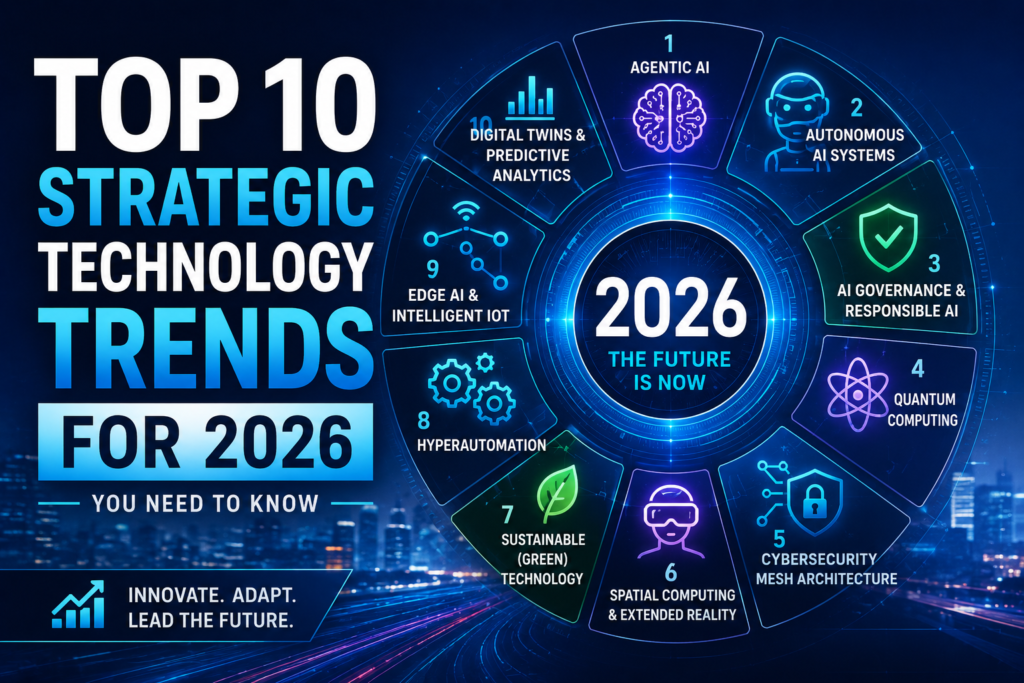
The Top 10 Strategic Technology Trends for 2026
1. Agentic AI: The Shift From Tool to Teammate
Most people who have used AI tools over the past few years think of them the way they think of a very smart search engine. You ask a question, you get a response, you decide what to do with it. You are still the one driving every decision.
Agentic AI is a fundamentally different thing and understanding the difference is probably the most important single concept in any top 10 strategic technology trends for 2026 discussion this year.
An AI agent is given a goal rather than a question. It then figures out what steps are needed to accomplish that goal, executes those steps using whatever tools and data it has access to, evaluates whether the results match what was intended, adjusts its approach when they do not, and keeps going until the objective is met. It might browse the web, write and execute code, send emails, update records, pull reports, and coordinate across systems, all without a human approving each individual action.
Think about what that actually means for a workflow that currently involves five people passing work between each other over three days. An agent can potentially handle the handoffs, the checks, the adjustments, and the outputs in a fraction of the time with a fraction of the human attention currently required.
Deloitte projects that by end of 2025, 25% of companies using generative AI will have deployed agentic AI pilots, rising to 50% by 2027. Microsoft, Google, Salesforce, and ServiceNow have all built agentic capabilities into the core of their 2026 product roadmaps. This is not a niche development. It is the direction the entire enterprise software market is moving.
The practical question for any organization right now is not whether to eventually engage with agentic AI. It is which workflows to start with and how to design the human oversight that keeps agents operating within appropriate boundaries.
Read Also: Most Common Online Dating Scams: Red Flags You Should Never Ignore
2. Quantum Computing: Still Emerging But No Longer Theoretical
Quantum computing has spent most of the past twenty years being described as five years away from practical usefulness. I have used that joke in presentations. It stopped being fully accurate somewhere around 2024.
IBM has operational quantum systems running at over 1000 qubits. Google has continued building on its quantum research with systems that are producing commercially relevant results in controlled applications. Microsoft has pursued a different architectural path using topological qubits that may ultimately prove more stable than competing approaches. These are not the same machines that existed five years ago.
The industries where practical quantum application is arriving first matter to understand. Pharmaceutical companies are using quantum simulation to model molecular interactions at a resolution that classical computers simply cannot achieve, which is accelerating drug discovery timelines in meaningful ways. Financial institutions are beginning to explore quantum approaches to portfolio optimization and risk calculation problems that involve so many variables simultaneously that classical systems struggle with them. Logistics companies with genuinely complex routing and supply chain problems are finding that quantum approaches can find solutions that classical optimization cannot.
McKinsey estimates quantum computing could generate $450 billion to $850 billion in annual value by 2040, with early commercial results arriving well before that. For most businesses in 2026, the practical action is not deploying quantum hardware but understanding where quantum-as-a-service through IBM Quantum, Amazon Braket, or Microsoft Azure Quantum might address specific computational limitations in your operations. Building quantum literacy now positions you to move faster when the technology reaches broader commercial maturity, which is closer than it has ever been.
3. Spatial Computing: Mixed Reality Finds Its Purpose
Apple Vision Pro landed in early 2024 and while the $3,499 price point kept consumer adoption modest, it demonstrated a level of polish and capability that moved the entire spatial computing category forward significantly. The second-generation hardware in 2026 is lighter, more capable, more comfortable to wear for extended periods, and considerably more affordable. Competition from Meta, Samsung, and several other manufacturers has expanded both the market and the ecosystem around it.
Here is the thing about spatial computing that I think gets missed in a lot of new trends in information technology coverage. The consumer applications, the games, the entertainment, the productivity tools you use at home, are the visible part. The enterprise applications are where the genuinely transformative use is already happening.
Boeing documented a 40% reduction in production time for certain aircraft wiring harness assembly after deploying augmented reality guidance for technicians. The AR overlay shows workers exactly where each wire goes in real time, overlaid directly onto the actual aircraft they are working on, eliminating the constant back-and-forth reference to technical manuals that previously slowed the process and introduced errors.
Surgeons are using spatial overlays during procedures that map imaging data, the CT scan, the MRI, directly onto the patient on the table in real time. Training programs that previously required expensive physical simulators are being replaced by spatial computing experiences that provide comparable learning outcomes at a fraction of the cost. Field service technicians across industries from utilities to manufacturing are receiving expert guidance overlaid directly onto the equipment they are servicing.
The developers and designers building spatial experiences now are accumulating expertise in a platform that is growing. That expertise will become significantly more valuable as the installed base expands over the next three to five years.
4. AI-Powered Cybersecurity: The Arms Race Gets Serious
I want to be direct about something that does not get said clearly enough in most cybersecurity discussions. The same AI capabilities that are making your organization more productive are making the people trying to attack your organization more effective at exactly the same time. And they have fewer ethical constraints on how they use those capabilities than you do.
IBM’s 2024 Cost of a Data Breach Report put the average breach cost at $4.88 million, the highest figure in the report’s history. Phishing emails have become dramatically more convincing because large language models can now generate personalized, contextually accurate deceptive communications without the grammatical errors and awkward phrasing that previously made phishing relatively easy for trained employees to spot.
Deepfakes have crossed a quality threshold that matters practically. Earlier this year a finance employee at a multinational company transferred $25 million after what appeared to be a video call with the company’s CFO. The CFO was entirely AI-generated. The employee had no idea.
The security industry has responded by deploying AI defensively. Systems that learn what normal looks like in a network and flag anomalies the moment they appear rather than waiting for someone to notice. Identity verification that goes beyond passwords to behavioral patterns. Automated threat response that can contain a breach in seconds rather than the hours or days that human-only response requires.
Gartner projects that by 2028, AI will autonomously handle 50% of cybersecurity incident response activities that currently require human analysts. For 2026 the practical implication is that AI-augmented security tools are not a future upgrade. They are a current necessity for any organization handling data that matters.
5. Energy Technology: The Infrastructure Crisis Nobody Talks About Enough
This one belongs on every top 10 technology trends 2026 list and it rarely gets the attention it deserves because it sits at the intersection of technology and infrastructure rather than living in the software world where most technology coverage focuses.
Here is the situation plainly. The AI economy requires extraordinary amounts of electricity to run. Training large AI models and serving inference at scale through data centers is computationally intensive in ways that translate directly into energy consumption at a scale that is becoming a genuine constraint on the pace of AI deployment.
The International Energy Agency projects that data centers could consume up to 1,000 terawatt-hours of electricity annually by 2026, roughly double their 2022 consumption. Microsoft, Google, Amazon, and Meta are spending collectively hundreds of billions of dollars on data center construction and the energy supply to power those facilities is a real bottleneck that is shaping strategic decisions across the industry.
Microsoft signed a deal to restart a dormant reactor at Three Mile Island specifically to power its data centers. Google has signed agreements with next-generation nuclear developers. Amazon has made major renewable energy commitments across multiple markets. The technology industry is effectively becoming one of the largest drivers of energy infrastructure investment globally.
This creates significant opportunities in power generation, grid technology, battery storage, and the companies enabling the buildout of energy infrastructure the AI economy requires. It also creates a sustainability mandate that is increasingly becoming a competitive factor as customers, regulators, and investors all pay closer attention to how organizations power their technology operations.
6. Humanoid Robotics: From Research Project to Factory Floor
Three years ago humanoid robots were either university research projects or expensive demonstrations that performed impressively in controlled environments and failed immediately in real-world conditions. Anybody who followed Boston Dynamics for a decade has seen both the impressive and the embarrassing ends of that spectrum.
Something has shifted and it has shifted faster than most people outside the robotics industry expected.
Figure AI, Agility Robotics, Boston Dynamics, and Tesla’s Optimus program have all produced systems in 2025 and 2026 that are demonstrating genuine, sustained utility in real operating environments. BMW has deployed Agility Robotics’ Digit in production facilities doing actual work that matters to production throughput. Amazon has been running humanoid robot trials in fulfillment centers under conditions that are nowhere near controlled or simple.
The economic logic behind humanoid robots is compelling in a way that previous generations of robotics were not. Most industrial robotics requires either significant modification of physical spaces to accommodate the robot’s specific movement requirements, or limits the robot to a single highly specialized task. Humanoid robots can operate in spaces designed for humans without facility modifications and can, at least in principle, perform multiple different tasks that would previously each require dedicated equipment.
Goldman Sachs projects the humanoid robot market could reach $38 billion by 2035, with meaningful commercial deployment beginning in the 2027 to 2028 window. The reason 2026 matters is that the early enterprise deployments happening right now are generating the operational data and practical learning that will inform and accelerate the mass deployment phase. The organizations involved in those early deployments are building competitive understanding that will be difficult to replicate later.
7. Personalized Medicine: Healthcare Finally Treating People as Individuals
Healthcare has always aspired to treat patients as individuals rather than applying population-average protocols to everyone with the same diagnosis. For most of medical history, that aspiration was limited by what was practically knowable about any individual patient. The combination of genomic sequencing, AI-powered analysis, and increasingly sophisticated biological understanding is making individual treatment genuinely operationally possible in 2026.
The cost trajectory of whole-genome sequencing tells the story clearly. It cost roughly $1 billion to sequence a human genome in 2001. It costs under $200 in 2026. That price reduction has transformed genomic data from a research luxury into a practical clinical tool that is increasingly integrated into standard care pathways.
Cancer treatment has moved furthest along this curve because the stakes are highest and the evidence base is strongest. Oncology teams routinely sequence tumor genomes to identify specific mutations that predict response to particular therapies. This allows treatment selection based on the molecular characteristics of an individual patient’s specific cancer rather than statistical averages across everyone with that cancer type. The outcomes in several cancer categories have improved dramatically compared to protocol-based approaches.
Beyond oncology, AI-powered drug discovery is compressing development timelines that previously stretched across decades. DeepMind’s AlphaFold work on protein structure prediction has fundamentally changed what is computationally accessible in drug development. Pharmaceutical companies integrating these capabilities into their development processes are building advantages that are already visible in their clinical pipeline productivity.
8. Edge AI: Moving the Intelligence Closer to the Action
The standard model for AI has been to send data to centralized cloud servers, do the processing there, and send results back. For plenty of applications, that works perfectly well. For applications where the round-trip time to a cloud server adds unacceptable latency, where connectivity is unreliable, or where sending data off-device creates privacy or regulatory problems, it creates genuine limitations.
Edge AI moves the processing closer to where the data is created. Your phone already does substantial AI processing locally. Face recognition, camera computational photography, voice processing- none of that goes to a server and back. The expansion of this capability into industrial equipment, medical devices, autonomous vehicles, retail systems, and infrastructure is happening somewhat invisibly because the AI is embedded in the systems rather than surfaced as a visible product.
IDC projects the edge AI market will reach $59.6 billion by 2026, driven by more powerful local processors, more efficient AI model architectures that can run on constrained hardware, and the growing list of use cases where cloud-dependent AI simply cannot meet requirements.
Manufacturing is where I see the most compelling near-term edge AI applications. Real-time quality control that catches defects as products come off a production line without network round-trips adding latency. Predictive maintenance on equipment that might not have reliable connectivity but absolutely cannot afford unexpected downtime. Process optimization that responds to conditions in milliseconds rather than seconds. These are real problems that edge AI is solving in real factories right now.
9. Trust and Governance: The Competitive Advantage Most Organizations Are Ignoring
I want to push back on the framing that treats AI governance as a compliance exercise rather than a strategic one because I think that framing is causing organizations to systematically underinvest in something that is going to matter significantly more than they currently believe.
Regulatory pressure is tightening across major markets simultaneously. The EU AI Act is enforced. US state-level AI regulations are multiplying. The legal exposure associated with AI systems that produce biased, inaccurate, or harmful outputs is being tested in courts in ways that are establishing precedents that will affect every organization using AI in consequential decisions.
But beyond the regulatory piece, customer behavior is changing in ways that have commercial implications. Research consistently shows that consumer trust in how organizations handle AI and data is becoming a meaningful purchasing factor. Organizations that can demonstrate trustworthy AI practices are converting that demonstration into customer confidence and customer retention in measurable ways.
Gartner’s research finds that organizations investing in AI transparency and governance are projected to achieve 40% higher customer trust scores than those that do not, and customer trust scores have direct, measurable relationships with revenue in every industry that has been studied.
The practical elements that matter competitively are explainability, meaning the ability to show how AI-driven decisions are made, fairness auditing that identifies and corrects for bias, robust data governance, and clear accountability for AI-generated outcomes. These are new trends in information technology governance that most organizations are underbuilding relative to their strategic importance.
Read Also: Future Critical and Emerging Technologies in AI, Robotics & Cybersecurity
10. Green Technology: Sustainability Becomes a Business Imperative
The clean energy investment wave that accelerated through the early 2020s has matured in 2026 into something qualitatively different from what it was a few years ago. The difference is that the economic case for sustainable technology has become as compelling as the environmental case in many segments, and that is when adoption really accelerates because it stops being a values decision and becomes an operational one.
Solar and wind energy costs have continued declining to the point where renewable energy is now the cheapest source of new electricity generation in most global markets. Not cheapest with subsidies. Cheapest. Battery storage technology improvements are addressing the intermittency problem that previously limited how much renewable energy could be reliably integrated into the grid.
For technology companies the sustainability conversation in 2026 is inseparable from the energy conversation described earlier. The organizations achieving the best performance per watt ratios in their computing infrastructure have real cost advantages that compound at the scale these companies operate. Chip manufacturers are competing intensely on efficiency. Data center operators are innovating on cooling and power management. These efficiency improvements are driven by economic necessity as much as environmental commitment.
BloombergNEF projects clean energy investment will reach $1.77 trillion in 2026, surpassing fossil fuel investment for the third consecutive year. The technology companies enabling this transition represent some of the most significant long-term investment opportunities in the current environment, and the organizations building sustainable computing practices now are positioning themselves advantageously for a regulatory and customer environment that is clearly trending in one direction.
How These Trends Reinforce Each Other
One thing I genuinely believe gets underemphasized in most top 10 strategic technology trends for 2026 coverage is how these trends amplify each other when they intersect. The combinations matter as much as the individual capabilities.
| Trend | What It Depends On | What It Enables |
| Agentic AI | Edge computing, cloud infrastructure | Autonomous workflows, humanoid robots |
| Quantum Computing | Energy infrastructure | Faster AI training, drug discovery |
| Spatial Computing | Edge AI, 5G connectivity | New interfaces for all other trends |
| AI Cybersecurity | Cloud and edge AI | Protects infrastructure all trends depend on |
| Energy Technology | Materials science, policy | Powers data centers, enables everything else |
| Humanoid Robotics | Edge AI, agentic systems | Physical automation across industries |
| Personalized Medicine | Quantum computing, genomics, AI | Better outcomes, faster drug development |
| Edge AI | Advanced chips, efficient models | Enables robotics, spatial computing, manufacturing |
| Trust and Governance | Legal frameworks, organizational culture | Determines deployment speed for all other trends |
| Green Technology | Energy storage, grid infrastructure | Sustainable foundation for AI economy |
Frequently Asked Questions
Q1: Which of the top 10 strategic technology trends for 2026 matters most for small businesses right now?
Honestly, agentic AI is where I would focus first if I were running a small business in 2026. Not because it is the most technically impressive thing on this list but because the tools are already available, they do not require significant capital investment, and the workflow automation benefits are accessible without a dedicated technical team. Most major business software platforms have added substantial AI capabilities in the past 18 months that most small business users are not yet taking advantage of. Start there before worrying about quantum computing or humanoid robots. AI cybersecurity is the second priority because the threat environment has shifted in ways that affect businesses of every size and the tools to address it are increasingly accessible.
Q2: How are the top 10 technology trends 2026 different from what was being discussed two years ago?
The biggest difference is that the conversation has shifted from potential to performance. Two years ago most of these trends were represented as things that were coming and that organizations should prepare for. In 2026 they are generating actual revenue, producing documented operational results, and in several cases disrupting established business models in ways that are showing up in financial statements. Agentic AI, humanoid robotics, and edge AI in particular have crossed from interesting pilot projects to production deployment at scale in a way they genuinely had not in 2024. The urgency is different because the results are visible rather than projected.
Q3: What skills should someone develop to stay relevant given these new trends in information technology?
The skill that consistently sits at the intersection of every trend on this list is what I would call applied AI literacy. Not the ability to build AI systems, though that is valuable, but the ability to understand what AI can and cannot do, evaluate claims about AI capabilities critically, identify where AI creates genuine value in your specific domain, and work effectively alongside AI systems as a collaborator rather than just a user. Domain expertise combined with that kind of AI literacy is proving more valuable than pure technical skill in most professional contexts right now because it is rarer and much harder to develop quickly. Beyond that, cybersecurity awareness, data interpretation skills, and comfort with ambiguity and rapid change are the capabilities that seem to hold value across every scenario I can imagine for the next five years.
Q4: Is quantum computing something most businesses need to act on in 2026?
For most businesses, it is a watching brief rather than an action item right now. The practical exceptions are organizations in pharmaceuticals, financial services, logistics optimization, and materials science where specific computational problems exist that quantum approaches are beginning to address. For those organizations, building quantum literacy, exploring available quantum-as-a-service options through cloud providers, and identifying specific use cases worth piloting is genuinely worth doing in 2026. For everyone else, the most immediately practical quantum concern is actually about security. Current encryption standards will eventually be vulnerable to sufficiently powerful quantum computers, and quantum-resistant cryptography is something IT teams should understand even if deployment is still a few years out.
Q5: Why does trust and governance belong on a strategic technology trends list rather than a compliance checklist?
Because the organizations treating it as a compliance checklist are going to find out the hard way that it was actually a strategic decision. The regulatory exposure from AI systems that produce harmful or biased outcomes is real and growing. The customer trust differential between organizations that can demonstrate responsible AI practices and those that cannot is measurable and commercially significant. And perhaps most practically, organizations with robust governance frameworks can actually move faster with AI deployment because they have already worked through the questions that slow down or block deployment for organizations that skipped that work. Governance done well is not a brake on innovation. It is the thing that lets you move confidently rather than hesitantly.