
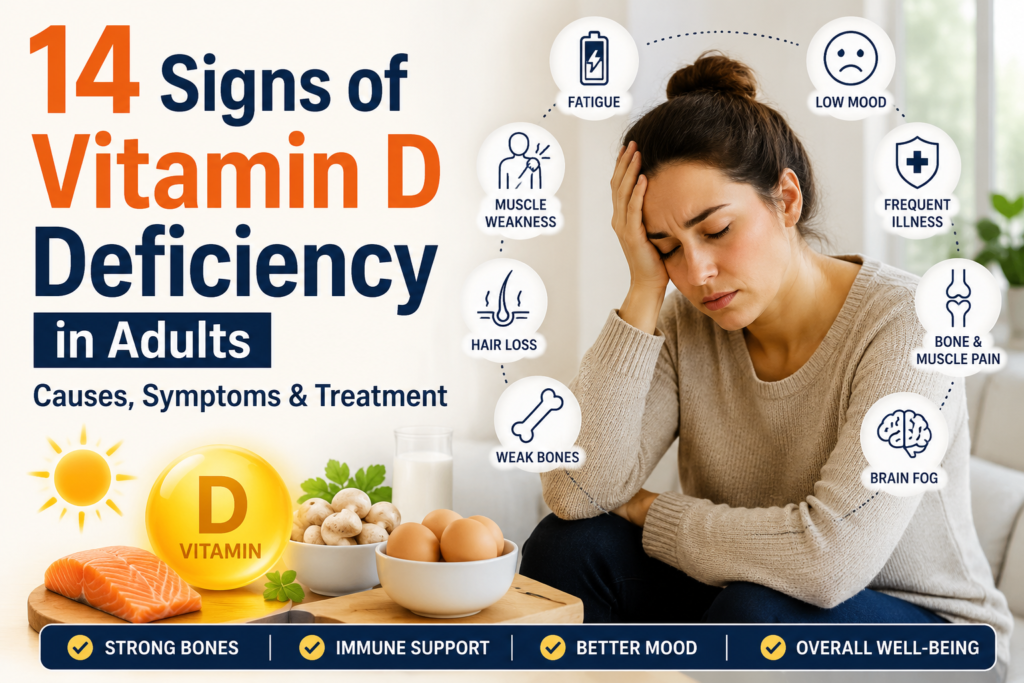
You are eating properly. You get enough sleep. There’s nothing wrong with what you do. But something is going on lately that you can’t put your finger on. Feeling tired despite plenty of rest. Feeling achy for no apparent reason. Catching colds and other illnesses more frequently.
Many people believe it’s just their stress and aging that cause all these problems, but in fact, the real cause is far easier to name: 14 signs of vitamin D deficiency often begin with symptoms that many adults overlook.
It’s a more common problem than people think. According to the WHO, vitamin D deficiency afflicts almost one billion people around the world. According to a study done at Nutrition Research, about 41.6% of Americans suffer from vitamin D deficiency, with an even higher percentage among darker skin types. Vitamin D deficiency, which is very common yet underdiagnosed, is called one of the most common nutritional deficiencies by the Cleveland Clinic, mostly due to the dismissible nature of its symptoms.
Here are 14 symptoms of vitamin D deficiency adults ignore most often.
Why Vitamin D Matters More Than Most People Think
Many people searching for vitamin D level 14 symptoms are surprised to learn that even moderately low levels can affect multiple body systems.
Vitamin D functions more like a hormone than a vitamin. It directly affects over 200 genes and is involved in calcium metabolism, immune function, muscle function, brain biochemistry, and anti-inflammatory activity. All tissues have receptors for vitamin D, and hence its deficiency impacts all parts of the body simultaneously.
Vitamin D is produced by your body mainly from sun exposure. While you can take supplements from fatty fish, eggs, and fortified milk, our current lifestyle makes it very hard to achieve sufficient levels. The only test to identify whether you have sufficient levels of vitamin D is the blood test that measures 25-hydroxyvitamin D. A level of less than 20 ng/mL is considered to be deficient, while a level of 20 to 30 ng/mL is considered insufficient.
Understanding the 14 signs of vitamin D deficiency can help you seek treatment before complications develop.
Read Also: 10 Uses of Artificial Intelligence in Daily Life: How AI Is Changing the Way We Live
14 Signs of Vitamin D Deficiency
1. Fatigue That Sleep Does Not Fix
Persistent, heavy exhaustion that is present in the morning and does not improve with rest is the complaint that brings more deficient adults to their doctor than almost anything else. A study in the North American Journal of Medical Sciences found a direct link between low vitamin D and fatigue severity, with significant energy improvement after levels were corrected.
2. Bone Pain and Achiness
In cases when there is not enough vitamin D in the body, calcium absorption by bones becomes problematic, resulting in osteomalacia, making bones softer and painful. The pain is located in the lower back, hips, pelvis, and thighs and is described as a dull ache. According to a study from the Archives of Internal Medicine, 93% of patients who visited doctors with constant muscle pain had vitamin D deficiency.
3. Muscle Weakness
Vitamin D receptors can be found in muscles; thus, in case of its deficiency, muscle fibers work inadequately, and this problem is associated mainly with proximal muscles like thighs, hips, and shoulders. In adults, problems like getting up from chairs, climbing stairs and raising hands appear for no apparent reason.
4. Always Being Sick
Vitamin D stimulates antimicrobial proteins and influences the inflammatory process of the immune system. An analysis conducted on 11,321 people from 25 clinical studies in the British Medical Journal demonstrated that taking vitamin D helped reduce the frequency of acute respiratory diseases, particularly in those people who had the highest deficiency of vitamin D. Chronic infection that heals slower than usual is one of the symptoms of low vitamin D levels.
5. Depression and Low Mood
Vitamin D receptors are found throughout the brain in areas that regulate mood. Vitamin D also influences serotonin synthesis directly. A meta-analysis in the British Journal of Psychiatry reviewing over 31,000 participants found a significant association between deficiency and depression. Low mood appearing without obvious life stressors and not responding to standard approaches warrants a vitamin D test alongside other investigations.
6. Slow Wound Healing
Vitamin D plays an active role in new skin production, inflammation control at injury sites, and infection prevention. Research in the Journal of Dental Research found that participants with low vitamin D showed significantly delayed healing following surgical procedures compared to those with adequate levels.
7. Hair Loss
Vitamin D plays a role in the hair follicle cycle, specifically initiating new hair growth. Research has linked low levels to alopecia areata and general diffuse thinning in both men and women. A study in Skin Pharmacology and Physiology found that women experiencing hair loss had significantly lower vitamin D levels than control participants.
8. Lower Back Pain
Insufficient levels of vitamin D affect calcium balance in the vertebrae, cause muscle weakness leading to poor support of the spine, and provoke inflammation, which enhances pain sensitivity. According to a study based on National Health and Nutrition Examination Survey data, individuals with deficiency were statistically much more prone to suffer from chronic low back pain regardless of their age, body weight, and physical activity.
9. Brain Fog and Trouble Focusing
Lack of concentration, slow reaction time, and forgetfulness are some of the most bothersome symptoms related to vitamin D blood levels. Vitamin D promotes proper neurological functions via nerve impulse conduction, regulation of inflammation in the brain, and neuroprotection. Scientists at Tufts University have proved that people performed worse on attention, speed of processing, and executive function tasks.
10. Recurrent Headaches
The ability of vitamin D to regulate inflammation and pain sensitivity is connected with its impact on the processes of prostaglandin production and calcium channel functioning. According to the research in the Journal of Headache and Pain, deficient individuals were characterized by significantly lower vitamin D blood levels than individuals with no headache disorders.
11. High Blood Pressure
Vitamin D is known to regulate the renin-angiotensin hormone system, which controls blood pressure. Deficiency in the vitamin leads to the dysregulation of the same. Studies carried out at Harvard School of Public Health show that vitamin D-deficient adults were 60% more likely to develop high blood pressure within a period of ten years.
12. Poor Fat and Vitamin D Absorption
Medical conditions such as Crohn’s disease, celiac disease, and post-bariatric surgery cause poor fat absorption, hence affecting vitamin D absorption since vitamin D is fat-soluble. It should be noted that vitamin D deficiency contributes to poor gut absorption, causing inflammation, hence creating a vicious circle of deficiency causing gut issues that cause deficiency.
13. Excessive Sweating
Excessive sweating, especially on the head and face not attributable to high temperatures or exercise, is a clinically diagnosed symptom of vitamin D deficiency in patients.
14. Anxiety and Nervous System Dysregulation
Vitamin D regulates neurotransmitters involved in the stress response and modulates the HPA axis governing how the body handles perceived threats. A systematic review in Nutrients found a significant inverse relationship between vitamin D levels and anxiety symptoms across multiple study populations, meaning lower vitamin D consistently correlated with higher anxiety scores.
Read Also: Protein for Muscle Growth: Foods, Supplements, and Expert Tips
Quick Reference Table
The 14 signs of vitamin D deficiency listed above affect multiple body systems and should never be ignored. The following vitamin D level 14 symptoms are among the most commonly reported by adults.
| Sign | System Affected | Frequency in Deficiency |
| Persistent fatigue | Energy and metabolism | Very common |
| Bone pain | Skeletal system | Very common |
| Muscle weakness | Musculoskeletal | Common |
| Frequent illness | Immune system | Very common |
| Depression and low mood | Neurological | Common |
| Slow wound healing | Skin and immune | Moderate |
| Hair loss | Follicle function | Moderate |
| Lower back pain | Skeletal and muscular | Common |
| Brain fog | Neurological | Common |
| Frequent headaches | Neurological and vascular | Moderate |
| High blood pressure | Cardiovascular | Common |
| Gut absorption issues | Digestive | Common in high-risk groups |
| Excessive sweating | Nervous system | Less common |
| Anxiety | Neurological and endocrine | Common |
Recognizing the 14 signs of vitamin D deficiency early allows treatment before long-term complications develop.
Who Is Most at Risk
Those spending the most time indoors, residing at high latitudes, with dark skin colors, aged over 65 years, being overweight, and having fat malabsorption syndrome have been found to be more prone to vitamin D deficiencies. Darker adults require more sun exposure to synthesize the same amount of vitamin D as other people, and this accounts for the increased rates observed in Black and Hispanic Americans.
People experiencing vitamin D level 14 symptoms should speak with their healthcare provider about appropriate testing.
How It Is Diagnosed and Treated
Only a 25-hydroxyvitamin D level check is required. In case of moderate deficiencies, most doctors prescribe between 2,000 and 4,000 IU of vitamin D3, which is its most bioavailable form, per day. High-dose treatment is prescribed in case of severe deficiency in amounts of 50,000 IU weekly for eight to twelve weeks.
Dietary changes can help but are often insufficient. Consuming more fatty fish, eggs, dairy with added vitamin D, and sun-exposed mushrooms can help but are unlikely to fix the deficiency problem. Between fifteen and thirty minutes of midday sun on your arms and legs several times a week in months when there is enough UVB radiation in your area can be helpful.
Vitamin D3 should be taken along with a meal that contains good fats. It is now being advised to take it along with magnesium as well, because magnesium is essential for activating vitamin D3 and people who lack vitamin D often also lack magnesium.
Frequently Asked Questions
Q1: How many of the 14 vitamin D deficiency signs have to be there before having a test done?
Truthfully, even one or two signs, especially together and especially when fatigue accompanies bone pain or illness, should be sufficient grounds to demand a test. A 25-hydroxyvitamin D test is fairly cheap and very quick to deliver an answer. If you notice several of the 14 signs of vitamin D deficiency, you should consider getting tested.
Q2: What is defined as the extremely low level of vitamin D?
Levels of vitamin D under 12 ng/mL are deemed dangerously low and associated with health problems such as osteomalacia, compromised immunity, and high risks of diseases. Vitamin D deficiency symptoms become common and severe once the levels go below 20 ng/mL. Many people asking about vitamin D level 14 symptoms are referring to blood test results showing significant deficiency.
Q3: Is it possible to obtain sufficient levels of vitamin D from food sources only?
In most cases – no. Foods with the highest content of vitamin D require too much consumption in order for you to obtain a sufficient amount, which the majority of people can not consume on a regular basis.
Q4: How soon do you start feeling well once supplementing?
Improvement in energy and mood is observed in about four to six weeks in many cases among adults. Symptoms like bone pain and muscle weakness may take two to three months to improve noticeably. The blood levels need to be checked again in three months to make sure that your correction is sufficient and the proper dosage is set.
Q5: Is there an upper limit for vitamin D?
Yes, but the occurrence of toxicity is significantly rare compared to deficiency and almost always happens due to overuse of the supplement, usually when taking more than 10,000 IU per day persistently. Your levels can be tested before and while you use vitamin D supplements to prevent such a situation from happening.
Q6: Will vitamin D deficiency put you at higher risks of some severe diseases?
Vitamin D deficiency is repeatedly linked to high risks of developing osteoporosis, heart problems, diabetes, multiple sclerosis, some autoimmune diseases, and cancer. The importance of having appropriate levels of this vitamin for overall health is recognized by most nutritionists and internists, since the correlation covers all disease areas.
Knowing these 14 signs of vitamin D deficiency can help you take action before the condition worsens. If you recognize several vitamin D level 14 symptoms, schedule a blood test rather than relying on symptoms alone.