Be honest with yourself for a second. When did you last get directions without asking anyone? When did a song recommendation surprise you with how well it fit your mood? When did your bank catch a weird charge before you even saw it?
That was all AI. And you probably did not think about it for even a second.
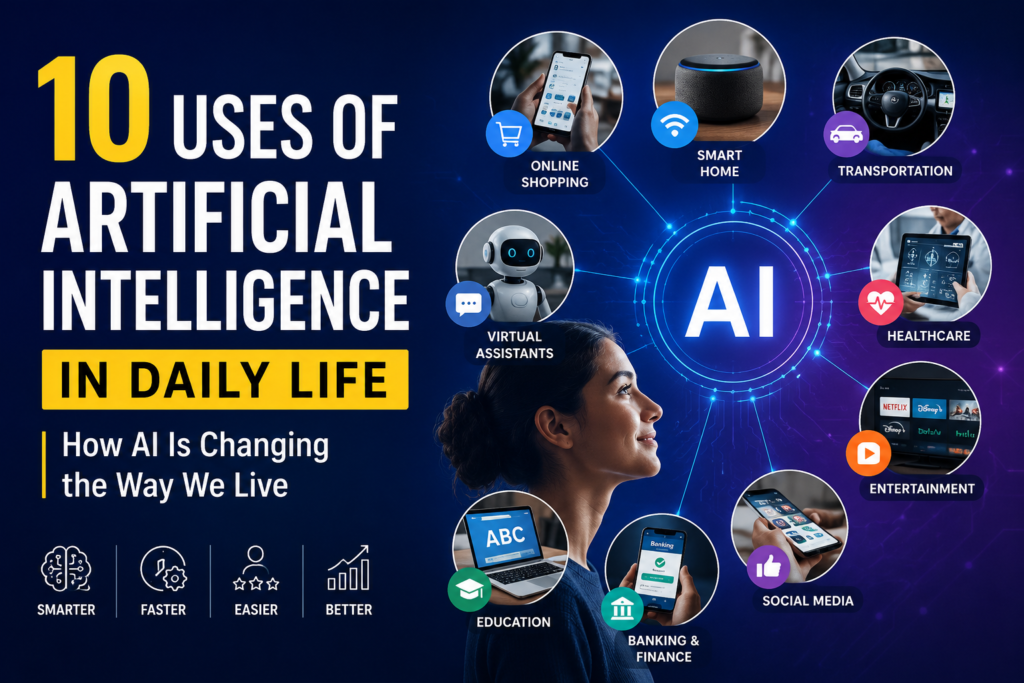
That is actually the point. The best technology disappears into the background of your life and just works. Artificial intelligence has reached that stage faster than most people expected, and understanding the 10 uses of artificial intelligence in daily life is less about marveling at the future and more about recognizing what is already happening around you right now.
According to McKinsey, 77% of people interact with at least one AI-powered product every single day. PwC puts the projected contribution of AI to the global economy at $15.7 trillion by 2030. Those are not predictions about what might happen. They reflect what is already well underway.
Here is where AI actually shows up in your life, probably more than you have ever stopped to consider.
1. The Voice Assistants You Ask Without Thinking
Ask Siri a question. Command Alexa to put on some tunes. Query Google about the closing time of an establishment. None of this sounds very amazing at all, but that’s amazing in and of itself.
The artificial intelligence behind these personal assistants uses natural language processing, a type of AI designed to recognize how humans really talk to each other, in all its nuanced imperfection. Just a few years ago, having a computer reliably understand human speech was a major technical hurdle to overcome. People now complain about being misunderstood by Alexa, which might be the best indicator that something is truly here to stay.
2. Recommendations That Know You Better Than You Think
Netflix suggests something, and you watch it. Spotify builds a playlist, and it is genuinely good. Amazon shows you something you did not know you wanted and you end up buying it.
Here is how AI assists us in our daily lives via one of the most commercially viable ways in which AI does so. Every time you use any of the platforms offering you recommendations, you are interacting with algorithms that have learned about you at an incredibly detailed level by cross-referencing your behavioral patterns with millions of other customers with the same tastes. Netflix has openly mentioned in their press releases that their recommendation system generates $1 billion worth of value from their customers annually just by keeping them entertained with their favorite shows.
3. Navigation That Thinks Several Steps Ahead
When you use Google Maps, it doesn’t just give you directions. It analyzes current traffic conditions among millions of users at once, uses previous data related to that exact hour of the day and day of the week, takes roadblocks and collisions into account from the latest reports, and updates its calculations based on changing conditions throughout your trip.
What you see on your side is simply a quiet suggestion to make a left turn in 300 meters. What’s actually taking place behind that suggestion is AI analyzing an incredibly large amount of data in seconds to determine the quickest route for getting you there. Seeing the extent of how AI benefits our lives through a seemingly mundane task such as navigation puts things in perspective pretty quickly.
4. Email Filters That Handle Thousands of Decisions You Never Make
Consider how few spam messages there are in your inbox these days. This is not because the spammers have given up trying. It is because machine learning algorithms trained on billions of emails learned to distinguish between valid and spam emails so effectively that spam never makes its way to you.
Gmail does not only block spam messages. Gmail also analyzes the tone and content of the incoming messages and proposes short responses for them. Gmail understands which messages and conversations are important for you and ranks them appropriately. Gmail categorizes promotions, social media messages, and personal messages automatically. All of those features require a machine to be taught to understand human communication sufficiently well so that it could make similar decisions to yours.
5. Banking Security Running Silently in the Background
Each and every single time you use your card to pay for something, the transaction you made gets analyzed by an AI algorithm first. It will evaluate your transaction geography, will see that your purchase amount is weird, will analyze your merchant category and your purchase pattern compared to previous purchases, and will quickly make a risk evaluation decision.
Mastercard evaluates 75 billion transactions every year through its AI-based fraud detection infrastructure, reducing the number of false fraud warnings by 80%. This means that not so many valid transactions get blocked while not so many fraudulent ones get approved. For you, personally, this is the case when artificial intelligence gets used in real life and you rarely realize it except when it fails to do it right.
Read Also: Top 20+ ServiceNow Interview Questions and Answers For Beginner(2026)
6. Healthcare That Is Getting Smarter Faster Than Most People Realize
On the consumer side, AI symptom checkers built into platforms like WebMD and Ada let people describe what they are feeling and get structured guidance about possible causes and urgency levels. That alone is meaningful for people who would otherwise wait days for a doctor’s appointment to ask a question that turns out to have an obvious answer.
On the clinical side, the pace of development is genuinely striking. Google’s DeepMind built an AI system that identifies more than 50 different eye diseases from retinal scans with 94% accuracy, matching the diagnostic performance of world-leading ophthalmologists. For patients in areas where specialist access is limited, that is not a novelty. It is access to a quality of assessment that simply would not have been available to them before.
7. Social Media Feeds Built Around Your Attention
No significant social media outlet uses chronological order to sort their content. The posts that are displayed to you on TikTok, Instagram, Facebook, and Twitter have been sorted through an AI system which analyzes your activity, viewing time, interactions, and preferences for content.
Moderation of this content works in the exact same manner, only at a scale that requires automation. At Meta, there are more than 100 billion pieces of content being processed daily on its various platforms. These pieces of content are flagged by an AI system before a human even sees the moderation queue.
8. Online Shopping Prices That Are Not What They Appear
None of the significant social media platforms utilize chronology to organize their content. The posts that are shown to you in TikTok, Instagram, Facebook, and Twitter have already been organized by an AI algorithm that takes into account your activities, time spent, interactions, and preferences for the content.
Content moderation is done in exactly the same way, just on a much larger scale, which necessitates automation. Meta has over 100 billion pieces of content posted on its platforms each day. This content is flagged by an AI algorithm before a human even gets to look at the moderation queue.
9. Smart Home Devices That Learn Your Habits
Programmable thermostats work on schedules that are manually pre-programmed. The Google Nest, a smart thermostat, does something entirely new with its technology. It analyzes your daily routines, senses occupancy in different rooms, adapts to the seasons and changing preferences, and adjusts the heating and cooling of your house accordingly without you having to control it.
Google has announced that the cumulative savings in electricity by using Nest thermostats is over 100 billion kWh since their launch. This number accounts for not just monetary savings by individual users but also an actual environmental contribution thanks solely to machine learning on the behavior of people at their houses.
10. Real-Time Translation That Has Changed Communication Forever
A decade ago, the only way to have reliable real-time translation between languages was to use a human translator. In contrast, today, Google Translate translates over 100 billion words per day in 133 languages through neural machine translation, which captures the sense of the context as opposed to translating individual words.
In addition to the above, DeepL and other tools have improved on the previous translation tools by delivering translations that capture both tone and sentence structure, something that could not be captured in previous technologies. This technology is now used everywhere, from traveling in countries where one cannot speak the language, communicating between companies across different borders without having a translation division, accessing educational content in foreign languages, among others.
Read Also: Best Phone in 2026: Expert Reviews of the Best Camera and Battery Phones
The Bigger Picture
The 10 uses of artificial intelligence in daily life covered here are not experimental or theoretical. They are running right now inside the apps, devices, and platforms that most people use before they finish their morning coffee.
The transformation that is taking place is no longer about the question of whether AI technology forms an integral part of your daily routine. This is evident beyond any doubt. What is transforming is the level of conscious involvement with AI, its clear perception and deliberate use of increasingly more advanced tools.
Frequently Asked Questions
Q1: What are the most common uses of artificial intelligence in daily life?
The ones most people encounter without realizing it are voice assistants, content recommendations on streaming and shopping platforms, real-time navigation, email spam filtering, and fraud detection in banking. These systems run in the background of experiences people consider completely routine, which is part of why the scale of AI adoption tends to surprise people when they actually look at the numbers behind it.
Q2: How does AI help us in daily life in practical terms?
The honest answer is that how AI helps us in daily life comes down to three things: time, accuracy, and personalization. Navigation saves commute time. Fraud detection catches problems faster than you could yourself. Recommendations reduce the time spent searching for things you might enjoy. Smart home devices handle energy management without requiring your attention. The common thread is that AI handles repetitive, high-volume decisions faster and more accurately than humans can manage manually.
Q3: Is AI in everyday life safe to use?
For the consumer applications most people interact with daily, the answer is generally yes. The more meaningful concerns around AI are about data privacy and how personal behavioral data is used at scale. Being intentional about which platforms you share data with and reviewing privacy settings on your most-used services gives you real control over your personal footprint in these systems.
Q4: Will AI take over jobs in everyday services?
AI is already automating specific tasks within jobs rather than eliminating entire roles in most industries. Routine customer service inquiries, basic scheduling, and pattern-recognition tasks are increasingly handled by AI systems. The roles that require genuine judgment, creativity, and human relationship management have not been replaced and do not show clear signs of being replaced in the near term. The more accurate picture is that AI is changing what jobs involve rather than making human workers unnecessary.
Q5: How will AI in daily life change over the next few years?
The evolution path lies along increased proactivity and customization. From devices monitoring your biometrics all the time to assistants helping you in creative and professional endeavors right when you need them to environments where your house anticipates your needs rather than reacts to your instructions — all this is currently being developed. The shift from using AI to being inside AI is already taking place in early adopter settings and is set to hit the general public this decade.