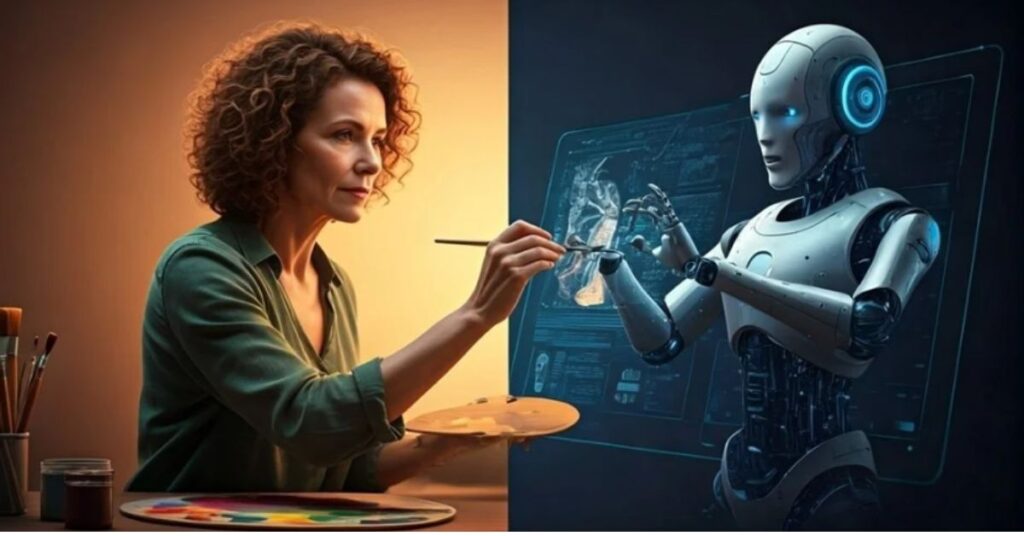
AI vs human creativity. All organizations have had the use of artificial intelligence technology even before now. They can generate text, generate imagery, compose music, and design things. This question often sparks the debate of AI vs human creativity, and the question of whether AI can replace artists and designers. But bearing in mind the amazing technological advancement that has occurred,
is it possible that artificial intelligence technology may rob humans of their creativity?
Such a question is raised all the time in any discussion involving the comparison of AI against human creativity in terms of efficiency.
Understanding What Creativity Really Means
However, the act of creation itself is not only about making an absolutely new idea. Creativity is a mode of communication that helps to communicate a person’s ideas. All those feelings we have, all memories we keep, all those meetings with other people – it all constitutes our humanity, and this human part is what gets involved in the act of creativity. So what makes a good story able to make people react? AI vs human creativity. That is why many still ask, ” Can AI replace artists and designers? And AI vs human creativity, AI serves as a useful tool. The ability of the movie to convey the unique experience of its director. Everything comes from within. This is why the issue of whether or not AI may substitute human creators remains relevant.
And this is the point where we talk about AI vs human creativity. The reason for that is very simple – machines are incapable of imitating humans. And then a whole topic opens up – can AI substitute human creativity?
How AI Approaches Creativity
This aspect makes AI very different. First, it does not have emotions or any other type of experience at all. It simply analyses huge quantities of information and comes up with something new out of this analysis. The fact highlights the differences between the debate around AI vs human creativity, whether AI can replace human creativity, and whether AI replaces artists and designers. In terms of using data vs life experience.
Common Myths About AI and Creativity
There are several myths about the creativity of AI. Some of those are listed below.
Myth 1: AI Is More Creative Than Humans
AI generates outcomes quicker than humans, but quickness doesn’t imply anything related to creativity. Originality and emotions are added by people.
Myth 2: AI Will Replace All Creative Jobs
Such myths usually occur. But the fact of the matter is that AI can only perform mechanical tasks. Analytical jobs cannot be handled by machines.
Myth 3: AI Creates Completely Original Work
Patterns in the dataset guide the learning process of AI and help generate outcomes based on these patterns. Originality can only be attributed to humans.
Myth 4: AI Understands What It Creates
Machines lack comprehension abilities. Humans give meanings to things.
The Real Strengths of AI in Creative Work
Here are some advantages of AI that contribute to creative processes.
Speed and Productivity: The speed of idea generation is one of the key advantages. AI saves time.
Idea Generation: It gives several ideas simultaneously. It aids in breaking creative blocks.
Cost Efficiency: Companies lower expenses by delegating simple work to AI.
Accessibility: AI enables novices to craft content effortlessly.
Where AI Falls Short
While it is highly effective, there are certain limitations to AI.
No Emotional Intelligence: The system cannot be emotional or have feelings.
Its work lacks depth.
No Personal Perspective: It does not have life experiences that allow for creation from a personal perspective.
Limited Innovation: AI systems follow patterns and rarely break rules or disrupt the established order.
Lack of Purpose: Human creation has purpose; however, AI creates without knowing the reason for doing so.
Consequently, AI will never be able to replace humans.
Truth: Creativity Needs Human Emotion
Emotion is vital for creation and inspiration. Emotion gives rise to stories, art, and innovations. Stories strike an emotional chord with us, as they relate to us.
We feel an emotional response to music. We feel an inspiration towards stories because we identify ourselves with them. The best types of artificial intelligence lack emotion.
They may be impressive, yet they miss something.
AI and Human Creativity: A Powerful Partnership
Rather than rivalry, the future is moving towards cooperation.
AI functions most effectively when used as a complement to the human. The AI performs the tedious work and streamlines processes. The human concentrates on innovation and planning.
Illustrations of this dynamic include:
- Writers utilizing AI for research and outlining
- Designers using AI for drafts and inspiration
- Marketing professionals using AI for content recommendations
In all these scenarios, the human refines the result.
Impact on Creative Careers
These advancements will transform how the creative sector operates. Some positions will change, while others might become obsolete.
Jobs at Risk
- Basic content writing
- Design using templates
- Routine editing
Jobs That Will Grow
- Creative direction
- Brand storytelling
- Strategy in content creation
- Management of AI tools
Creative workers need to adjust. Becoming familiar with AI technology may increase efficiency.
Future Reality: What Lies Ahead?
Still, it will need some data to work. It will neither have any emotions nor become self-conscious. Emotions are a human-only feature. The real issue here is whether AI can replace artists and designers. This is the reason why there is always the doubt that comes up about the possibility of AI replacing artists and designers and whether AI can replace human creativity, who rely heavily on their emotions and experience in their real lives. However, in reality, the actual problem is whether the role of AI in the future is going to be the replacement of artists and designers or creativity in general.
Ethical Considerations
Ethics are also an issue with AI. AI usually learns from pre-existing material. This creates problems such as:
- Concerns over copyright
- Failure to give credit to the original authors
- Excessive use of automated content
Authors have to use AI properly. Authors need to integrate AI with their own creativity.
Final Thoughts
Thus, can AI take control over human creativity?
There are many misconceptions about what AI is capable of. In reality, the truth lies somewhere in the middle. These human elements remain essential for meaningful creation. That is why many still ask, ” Can AI replace artists and designers? And AI vs human creativity, AI serves as a useful tool, but it should not be considered a replacement for human creativity.
Adaptation to change is necessary. This keeps the question alive: can AI replace human creativity, or is it simply a tool that enhances it? Human creativity will always beat technology.